10 Years, Enough Time to Conquer an Infectious Disease?
In an era where change is measured in seconds, ten years is more than enough time to bring about enormous change. What about infectious diseases? Over the past ten years, have we conquered infectious disease, or are we still fighting its recurring? Even with admirable advances in technology, when we recall the COVID-19 pandemic, no one can answer lightly.
If it is a disease that has already disappeared from high-income countries, we might hope that control is possible. In search of that possibility, we look back on a decade of change through cholera — a disease that may now feel unfamiliar to many people.
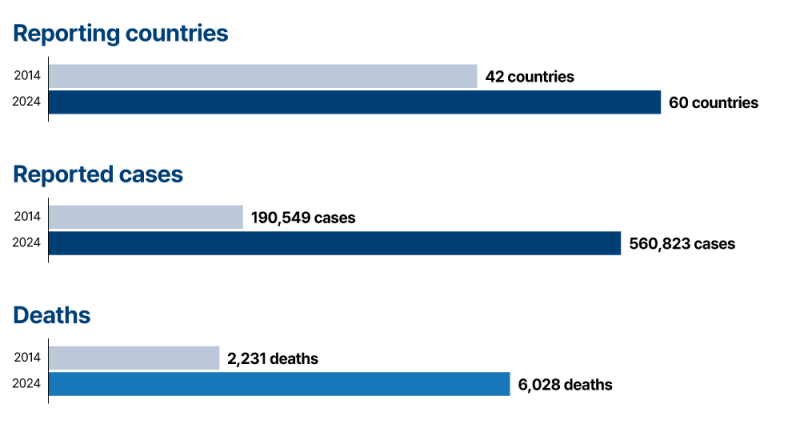
Based on official World Health Organization (WHO) reports. Depending on each country’s surveillance system, suspected and confirmed cases may be included, and differences in case definitions and testing capacity mean the figures may differ from the actual scale of occurrence.
Comparison of Cholera Reporting Countries, Cases, and Deaths in 2014 and 2024
Source: WHO, Weekly Epidemiological Record, “Cholera, 2014” (2015); WHO, Weekly Epidemiological Record, “Cholera, 2024” (2025)
A nearly threefold spike in global cholera cases between 2014 and 2024. Deaths increased about 2.7 times, and the number of countries reporting outbreaks also rose. Granted, a simple comparison is difficult because data collection methodologies and surveillance scopes have evolved over the decade. Even so, there is a reason these figures carry meaning.
In 2013, Gavi, the Vaccine Alliance decided to invest US$115 million over the five years from 2014 to 2018 to support a global stockpile system for the oral cholera vaccine (OCV). Then, in 2014, as WHO reactivated the Global Task Force on Cholera Control (GTFCC), the international community further strengthened its capacity to respond to cholera. As vaccine stockpiling and a system of international cooperation began to be built in earnest, there was growing hope that the cholera could gradually be brought under control.
However, ten years later, in 2024, cholera spread in more countries and on a larger scale.
Cholera, a Preventable Infectious Disease

Cholera is an acute waterborne infectious disease that is caused by ingesting water and food contaminated with the cholera bacterium (Vibrio cholerae)
Source: clipartkorea
Cholera is an acute diarrheal disease transmitted through water or food contaminated with the Vibrio cholerae bacterium. Severe dehydration can lead to death within 24 hours, but with prompt treatment using appropriate oral or intravenous rehydration, most patients can recover.

Changes in the Global Supply of Oral Cholera Vaccine (OCV)
Source: Gavi, the Vaccine Alliance. Roadmap for Oral Cholera Vaccines (2023)
Over the past decade, the supply of cholera vaccine has expanded. The global supply of OCV, which was only about 4 million doses in 2012, grew about ninefold to 35 million doses in 2022. In 2024, a new formulation, Euvichol-S, received WHO prequalification (PQ), opening the way to raise production. Consequently, by November of that year, OCV production reached its highest level since 2013.
Vaccine Supply That Cannot Keep Up with the Pace of Resurgence
However, the increase in vaccine supply did not immediately lead to a reduction in harm. This was because the pace of vaccine supply could not catch up with the pace of cholera resurgence. Behind cholera’s resurgence, several structural factors are driving this resurgence.
One of them is the climate crisis. Cyclones, floods, and droughts, which have grown more frequent and more intense due to the climate crisis, make access to safe drinking water difficult, weaken sanitation infrastructure, and create conditions in which cholera is still ongoing today.
According to WHO, from January 1 to February 15, 2026, the number of cholera patients reported in five southern African countries was 4,320, more than seven times the 586 reported in the same period of the previous year. Deaths also rose from 11 to 56. WHO explained that this increase was related to cyclone-induced flooding, infrastructure damage, the lack of access to safe drinking water among displaced populations, and poor sanitary conditions.

The number of people who have difficulty drinking safe water due to the climate crisis is increasing.
Source: clipartkorea
Another factor is conflict. In places where armed conflict has become prolonged, such as Sudan, Syria, and Yemen, health systems and water and sanitation infrastructure deteriorate at the same time.
The large-scale epidemic in Yemen, where the health infrastructure had collapsed due to civil war, was a major factor in the global number of cholera cases reaching an all-time high of about 1.2 million in 2017. At the time, the destruction of water and sewage facilities contaminated water sources and caused sewage to backflow, creating an environment in which the cholera bacterium spread rapidly. On top of this, populations whose immunity had declined due to malnutrition overlapped with localized outbreaks in conflict areas of Africa, and the global number of cases surged.

Annual Cholera Cases and Case Fatality Rate (CFR), 1989–2024
Source: WHO, Weekly Epidemiological Record, “Cholera, 2024” (2025)
The vicious cycle of conflict and cholera is still ongoing today. According to recent cumulative 2025 data, the Eastern Mediterranean Region reported the most cholera and acute watery diarrhea (AWD) cases in the world, with a total of 359,052. Among these, Afghanistan (164,820 cases), Yemen (93,496 cases), and Sudan (72,716 cases), which are still undergoing humanitarian crises, account for most of the total, proving that conflict areas remain at the forefront of cholera outbreaks.
While the factors driving the spread were growing, vaccine supply could not keep up. In 2024, requests for the global OCV stockpile reached 61 million doses, but the number of doses actually approved was 40 million doses across 16 countries. Even this was carried out under a single-dose strategy in order to distribute the limited supply more widely.
Since October 2022, in response to the supply shortage, the international community has applied a single-dose strategy instead of the existing two-dose schedule. This was an unavoidable measure to distribute the limited vaccine to more regions, but it had limitations in terms of the duration of protection.
Sustained Support for Cholera R&D
The data from the past decade clearly show that the cholera response requires not only an increase in vaccine supply but also sustained investment in faster and more effective research and response measures.
To address these limitations, the RIGHT Foundation has been supporting the project of a cholera conjugate vaccine (CCV) since 2019. This project is an international joint research and development project in which the International Vaccine Institute (IVI), EuBiologics, and Massachusetts General Hospital of Harvard Medical School collaborate. IVI, which has carried out this project as the principal investigator since 2022, plans to verify the CCV’s safety, immunogenicity, and manufacturability through future research and clinical trials, and to continue development with the goal of meeting WHO prequalification(PQ) standards.
[Cholera Vaccine Projects Supported by the RIGHT Foundation]